Syria Talks in Sochi Us Backed Do Not Attend
Prime Minister Naftali Bennett and Russian President Vladimir Putin agreed during their meeting in Sochi on Friday that the two nations would continue to implement the so-called deconfliction mechanism that works to prevent Israeli and Russian forces from clashing in Syria, a senior Israeli official said.
Housing Minister Ze'ev Elkin, who accompanied Bennett to act as a translator and advisor, said talks revolved around the theme of maintaining continuity in the countries' relationship after Prime Minister Benjamin Netanyahu was replaced by Bennett earlier this year.
According to Elkin, that included making sure the countries continued to work at avoiding conflict over Syria, where Russia is a main player backing the Syrian government and where Israel has waged a years-long campaign of airstrikes aimed at pro-Iranian fighters there.
There were "very wide" talks regarding the situation in Syria aimed at "safeguarding the coordination mechanism," Elkin said.
"The prime minister presented his world view on ways to stop Iran's nuclear drive and Iran's entrenchment in Syria," he said in a statement. "It was decided to keep policies vis-à-vis Russia in place (regarding airstrikes in Syrian territory.)"
Get The Times of Israel's Daily Edition by email and never miss our top stories
By signing up, you agree to the terms
"Russia is a very important player in our region, a kind of neighbor for us in the north," Bennett said after the leaders met at the Black Sea resort town for their first face-to-face talks since Bennett took office earlier this year, referring to Russia's large military presence in Syria.
"As such, our relationship with Russia is strategic, but also on an almost daily basis, and we need to maintain this direct and intimate discourse," Bennett wrote in a Facebook post.
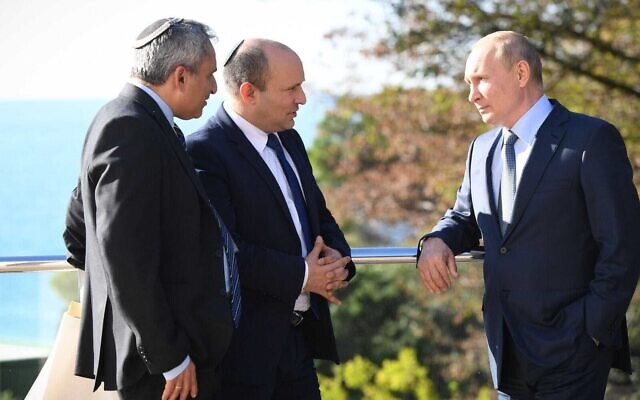
Prime Minister Naftali Bennett (C) speaks with Russian President Vladimir Putin (R) while accompanied by Housing Minister Ze'ev Elkin who acted as a translator at Putin's residence in Sochi, Russia on October 22, 2021 (Kobi Gidon/GPO)
In recent years Israel and Russia established a so-called deconfliction hotline to keep the sides from getting tangled up and accidentally clashing over Syria. Former prime minister Benjamin Netanyahu met Putin on multiple occasions to discuss the issue and claimed that their personal relationship was a main factor in keeping the mechanism.
Israel has carried out hundreds of airstrikes inside Syria in the course of the country's civil war, targeting what it says are suspected arms shipments believed to be bound for Lebanon's Iran-backed Hezbollah terror group, which is fighting alongside Syrian government forces. Israel rarely acknowledges or discusses such operations.
Russia meanwhile, is a close ally of Syria's Bashar Assad, has forces based and operating in Syria, and also provides Syria with its air defenses that try and shoot down Israeli jets and missiles.
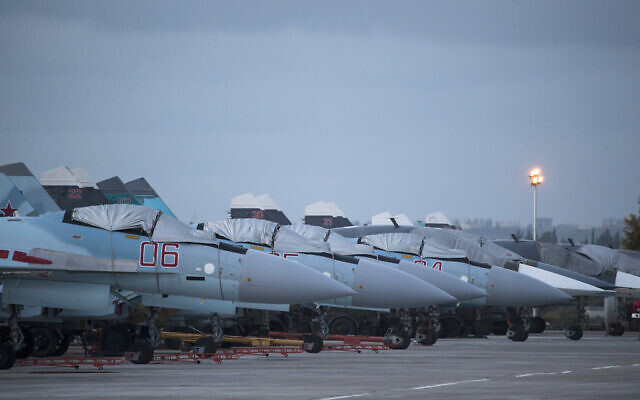
In this file photo taken on Friday, March 4, 2016, Russian Su-27 fighter jets and Su-34 bomber, right in the back, are parked at Hemeimeem airbase in Syria. (AP Photo/Pavel Golovkin, File)
Israeli officials do not generally discuss the full extent of that coordination, but they stress that the IDF does not seek Russian permission before carrying out operations.
The status of the deconfliction hotline has been uncertain since 2018, when a Syrian air defense gunner, aiming for Israeli jets on a bombing run, knocked a Russian military plane out of the sky instead, killing all 15 people on board.
Russia responded by providing Syrian forces with advanced S-300 air defense batteries, which were thought to have the potential to significantly curtail Israel's freedom of action in the skies over the country.
Moscow maintains state-of-the-art S-400 air defense systems to protect its own assets in Syria, but has never turned them on Israeli planes.
Israeli military analysts on both Channel 12 and 13 said Friday that during the meeting Putin agreed to Israel maintaining its freedom of action in Syria, but had asked for additional advanced warning of strikes.
There was no confirmation from the Kremlin or Russian comment following the meeting.
Russia has in the past made no secret of the fact that it is not happy with Israeli strikes in Syria.
In a joint summary statement by Russia, Turkey and Iran after the 16th Astana conference in June, the three parties "condemned continuing Israeli military attacks in Syria which violate the international law, international humanitarian law, the sovereignty of Syria and neighboring countries, endanger the stability and security in the region."
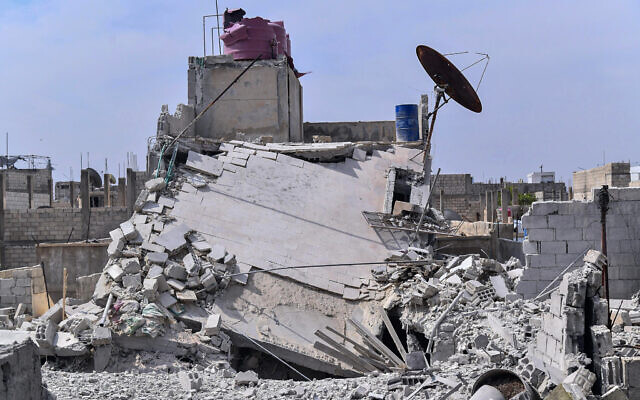
Illustrative: This photo released by the Syrian official news agency SANA, shows the rubble of a house that according to the Syrian authorities was attacked by an Israeli airstrike, in the Damascus suburbs of Hajira, Syria, Monday, April 27, 2020. (SANA via AP)
Russia has also repeatedly accused Israel of using civilian aircraft as a "shield" against Syrian air defenses, amid lingering anger over the 2018 incident.
Israel, as a rule, does not comment on specific strikes it allegedly carries out in Syria, but does generally acknowledge that it conducts operations against Iran-linked groups in the country in order to prevent the transfer of advanced weapons and to prevent attacks against Israel from Syria.
You're serious. We appreciate that!
We're really pleased that you've read X Times of Israel articles in the past month.
That's why we come to work every day - to provide discerning readers like you with must-read coverage of Israel and the Jewish world.
So now we have a request. Unlike other news outlets, we haven't put up a paywall. But as the journalism we do is costly, we invite readers for whom The Times of Israel has become important to help support our work by joining The Times of Israel Community.
For as little as $6 a month you can help support our quality journalism while enjoying The Times of Israel AD-FREE, as well as accessing exclusive content available only to Times of Israel Community members.
Join Our Community Join Our Community Already a member? Sign in to stop seeing this
Syria Talks in Sochi Us Backed Do Not Attend
Source: https://www.timesofisrael.com/israel-says-russia-agreed-to-not-hamper-idf-air-campaign-over-syria/
0 Response to "Syria Talks in Sochi Us Backed Do Not Attend"
Post a Comment